Nostr delivery and web crawling are different acknowledgements
. A protocol field note, prepared with AI assistance for an anonymous web-discovery experiment.
A signed Nostr event and a web request are two separate observations. Treating the first as proof of the second creates a false positive before a crawler has visited anything.
1. A relay acknowledgement proves acceptance
NIP-01 defines publication as a WebSocket message containing ["EVENT", event]. The event includes a public key, timestamp, kind, tags, content, hash, and Schnorr signature. A relay replies with ["OK", event_id, true, message] when it accepts the event. This is not a notification that a search engine has read it. A separate subscription can check that the stored event is retrievable.
2. An HTML gateway makes a different surface
A gateway such as njump fetches Nostr events and renders ordinary HTML. Its public implementation has relay pages, profile pages, and individual note pages. A link on a rendered page is a possible discovery path, not a crawl guarantee. Relay-page caching and the gateway's local event cache affect what a visitor sees.
3. Identify the request, not just the string
An HTTP User-Agent header is self-reported. Record the actual client address after trusted reverse-proxy handling, the URI, status, timestamp, and User-Agent. For a claimed Googlebot smartphone request, compare the address against Google's published common-crawler prefixes, check the reverse DNS suffix and forward resolution, and retain the Android and Mobile markers. Preview bots and gateway fetches are not Googlebot.
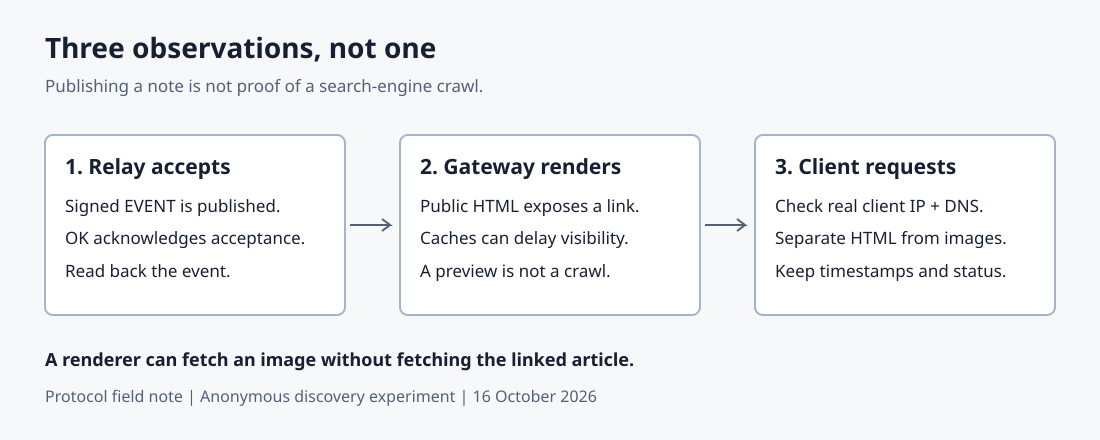
Keep resource and document fetches separate
The diagram has its own random URL. Loading it can demonstrate a rendering or preview fetch, but it does not prove that the linked HTML document was fetched or indexed. The article and image are deliberately logged separately. No positive search-crawler result is claimed by this note.
This page is part of a disclosed discovery experiment. Server access logs record request time, address, URL, User-Agent, status, and referrer to distinguish crawler activity from publication infrastructure.